
A crisp breadcrumb shell gives way to herbed chicken sausage and a boiled egg in the center. These homemade Scotch eggs get their savory flavor from English mustard, chives, thyme, and a pinch of ground mace. Each egg gets two coats of breadcrumbs before frying, which gives the crust its crunch. Start by choosing how firm you want the yolks, then set up the breading bowls while the eggs cool.
Why You’ll Love This Recipe Homemade Scotch Eggs
The filling uses plain chicken sausage meat, so the mustard and herbs come through in each bite. You can use panko from the pantry or homemade breadcrumbs, and the same breading sequence works for both. Dividing the sausage before you start wrapping gives you six individual Scotch eggs with a similar amount of meat around each one. Serve them whole or cut them into halves to show the layers.
Kitchen Tools You’ll Need
- Saucepan
- Bowl for an ice bath
- Mixing bowl
- Three bowls for breading
- Plastic wrap
- Deep, heavy pan
- Kitchen thermometer
- Paper towels
Ingredients
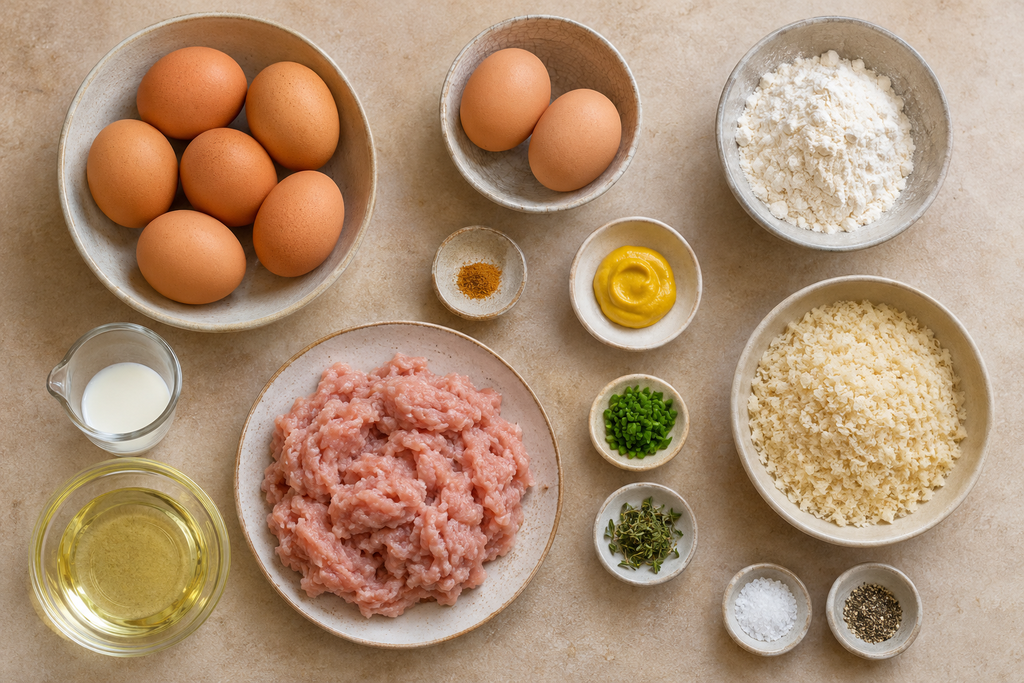
- 8 large eggs, 6 for boiling and 2 for the egg wash
- 1 lb (450 g) plain chicken sausage meat
- 2 tbsp finely chopped chives and thyme
- 1 pinch ground mace
- 1 tbsp English mustard
- A splash of milk
- ½ cup all-purpose flour
- 1 cup panko or homemade breadcrumbs
- Salt and black pepper, to taste
- Vegetable oil, for frying
How to Make Homemade Scotch Eggs
Step 1. Put six eggs in a saucepan and cover them with cold water. Bring the water to a boil, then reduce the heat and simmer for 5 minutes for softer yolks or 9–10 minutes for firm yolks. If you plan to serve the yolks soft, use pasteurized shell eggs. Transfer the eggs to an ice bath for at least 10 minutes, then peel them carefully so the whites stay intact
Step 2. Put the chicken sausage meat in a mixing bowl with the chopped chives and thyme, ground mace, English mustard, salt, and black pepper. Mix until the herbs are evenly distributed throughout the meat. Divide the mixture into six equal portions. Each portion will cover one boiled egg, and keeping them similar in size helps you get an even layer of sausage across the batch.
Step 3. Beat the remaining two eggs with a splash of milk. Put the flour in a second bowl and season it lightly with salt and pepper. Put the breadcrumbs in a third bowl. Set the bowls in the order you’ll use them: flour, egg wash, and breadcrumbs. The flour helps the egg wash cling to the sausage, and the wash gives the crumbs a surface to stick to.
Step 4. Flatten one portion of sausage between two lightly floured sheets of plastic wrap. Remove the top sheet. Lightly dust a peeled egg with flour and place it in the center of the sausage. Bring the edges of the meat up around the egg and pinch the seam closed. The wrapper should cover the whole egg. Repeat with the five remaining portions.
Step 5. Roll each wrapped egg in flour, dip it in the egg wash, and coat it in breadcrumbs. Dip it back in the egg wash and breadcrumbs for a second coat. The second pass fills in thin areas and builds a thicker crust. Look for an even layer of crumbs all the way around the egg, including the spot where you pinched the sausage closed.
Step 6. Fill a deep, heavy pan one-third full with vegetable oil and heat it to 325°F (163°C). Fry two Scotch eggs at a time, turning them occasionally so they brown evenly. Start checking at about 7 minutes. Keep cooking until the sausage layer reaches 165°F (74°C) on a thermometer. Measure the meat around the egg, then transfer the cooked Scotch eggs to paper towels to drain.
Serving Suggestions
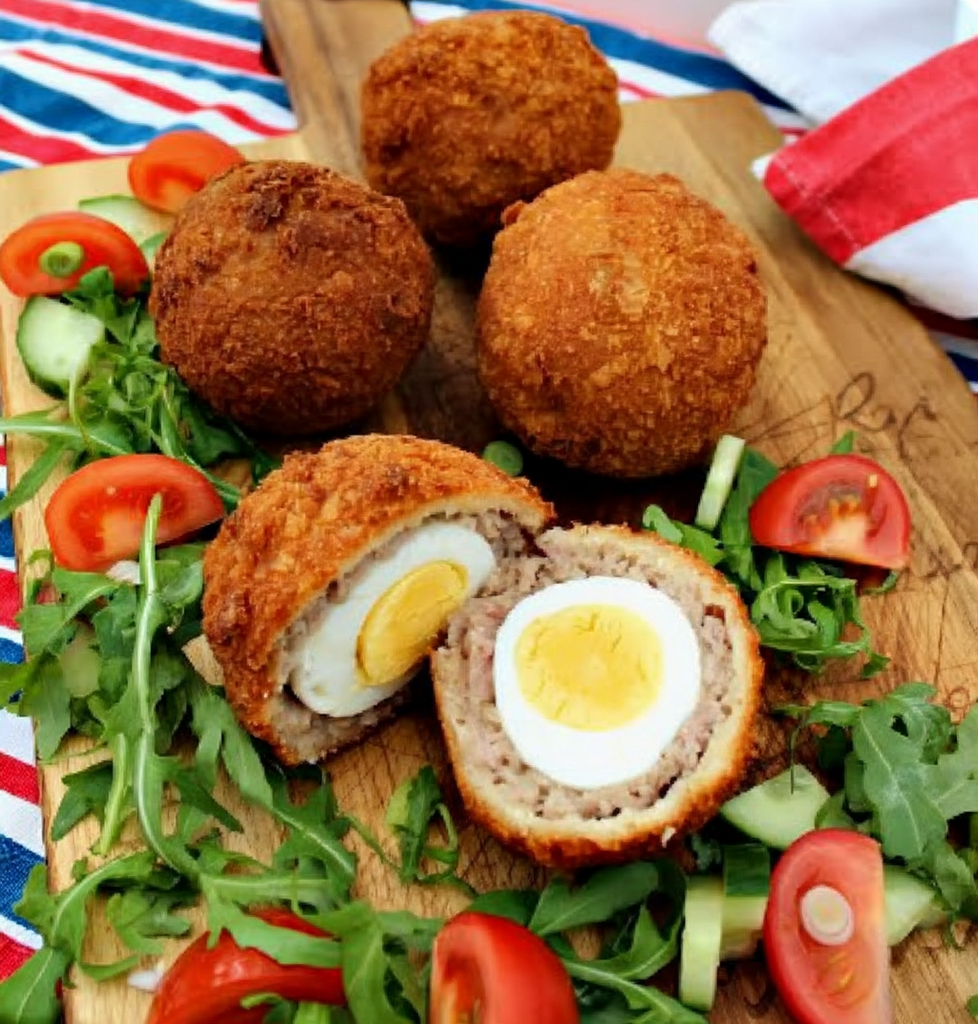
Serve the Scotch eggs warm after they’ve drained, when the breadcrumb crust is at its crispest. For an appetizer platter, cut each one in half so guests can see the egg, sausage, and crust in a single piece. Halves work well with softer yolks because the larger piece holds the center together. If you’ve cooked the yolks until firm, slice the eggs into quarters for smaller bites. You can also serve them whole for six individual portions. The English mustard is mixed into the sausage, so each slice already has a little tang alongside the chives and thyme.
Pro Tips for Best Results
- Use just enough flour on the plastic wrap to keep the sausage from sticking as you flatten it.
- Check how far the sausage reaches around the egg before you pinch the seam. The edges should meet without having to stretch the meat thin.
- Give each egg a moment to shed excess egg wash before it goes into the breadcrumbs. The crumbs are easier to distribute over a thin, even layer.
Common Mistakes to Avoid
- Rushing the ice bath. Warm eggs can be harder to handle, especially if you chose the shorter simmer. If a piece of white tears off as you peel, the sausage has an uneven surface to wrap around. Give the eggs at least 10 minutes in the ice bath and peel them gently.
- Eyeballing the sausage as you go. It’s easy to use too much on the first few eggs and end up short on the last one. Divide all six portions before wrapping. Seeing them side by side makes it easier to spot a portion that’s noticeably larger or smaller.
- Leaving a gap at the seam. Breadcrumbs can cover a bare spot without fixing the gap underneath. Before breading, check that the sausage edges meet and pinch them together. This gives you a continuous layer of sausage when you slice the egg.
- Stopping after the first coat. One pass leaves the egg looking breaded, but the second builds the thicker crust called for in this recipe. Once the first coat is on, go back through the egg wash and breadcrumbs so the second layer has something to cling to.
- Crowding the pan. Several eggs can be difficult to turn without bumping into each other, and adding them all at once can lower the oil temperature. Fry two at a time so you can turn them easily and give the paler spots a chance to brown.
- Going by color alone. The breadcrumbs can turn golden while the sausage still needs time. Use the seven-minute mark as a cue to start checking. Insert the thermometer into the sausage layer and keep frying until it reaches 165°F (74°C).
Variations & Substitutions
Use panko for a coarser crust or homemade breadcrumbs for a texture that depends on how finely the bread is crumbed. Use 1 cup of either and follow the same double-coating sequence. You can also choose between softer and firm yolks by following the corresponding simmer time in Step 1.
Storage & Reheating
- Refrigerator: Refrigerate cooked Scotch eggs in a shallow, covered container at 40°F (4°C) or below. Use them within 3–4 days. Refrigerate within 2 hours of cooking, or within 1 hour if the temperature is above 90°F (32°C).
- Reheating: Use a 350°F (175°C) oven to help crisp the breading. Heat until the center reaches 165°F (74°C) on a food thermometer. Whole eggs take longer to heat through than halves, so check the center before serving.
- Freezer: These Scotch eggs are best refrigerated. Boiled egg whites can turn rubbery and watery after freezing and thawing.
Nutrition Information
Estimated per serving of 1 Scotch egg. The recipe makes 6.
| Nutrient | Approximate amount |
|---|---|
| Calories | 300 |
| Total Fat | 15 g |
| Saturated Fat | 3 g |
| Carbohydrates | 17 g |
| Fiber | Less than 1 g |
| Sugar | 1–2 g |
| Protein | 25 g |
| Sodium | 750 mg |
The estimate uses a lean bulk chicken sausage and panko as reference products. It counts the listed breading and egg wash, models the splash of milk as 1 tablespoon, and assumes about 1 teaspoon of absorbed frying oil per egg. Sodium excludes the salt added to taste. The actual values will vary with the sausage brand, the amount of coating left in the bowls, and how much oil the crust absorbs.
Frequently Asked Questions
Can I make this recipe ahead of time?
Yes. For the crispest crust, hard-boil the six eggs the day before. Cool them in the ice bath and refrigerate them in a covered container, then wrap, bread, and fry them the day you plan to serve. You can also fry the full batch a day ahead, refrigerate it promptly, and reheat the Scotch eggs in the oven until the centers reach 165°F (74°C).
How long does it last in the fridge?
Fully cooked Scotch eggs keep for 3–4 days in the refrigerator at 40°F (4°C) or below when chilled promptly after cooking.
Can I freeze this recipe?
Freezing whole Scotch eggs is best avoided for texture. The cooked egg whites can turn rubbery and release water as they thaw. For a batch you’re making ahead, refrigerate the fully cooked eggs and reheat them when you’re ready to serve.
What can I substitute for one ingredient?
Use 1 cup of homemade breadcrumbs in place of the panko. The amount and breading sequence stay the same. The finished crust will reflect the size of your homemade crumbs.
Why didn’t my recipe turn out as expected?
If the crust came out patchy, check whether the egg wash reached the whole surface on both passes. If you found an exposed patch of egg white after frying, the sausage seam may have opened. An uneven layer of meat can also make some eggs take longer to cook, so check each batch with a thermometer before draining it.
Final Thoughts
The wrapping is the most hands-on part of making these Scotch eggs. Once the eggs are peeled and the sausage is divided, you can work through them one at a time and see where each wrapper needs to come together. The chives and thyme are visible when you slice through the meat, while the mustard and mace give the sausage a warm, savory flavor. A firm yolk makes a tidy wedge for sharing. If you’re serving the batch warm, cut the eggs after they’ve drained to show the contrast between the golden crust, the sausage, and the center.
Homemade Scotch Eggs
Equipment
- Saucepan
- Bowl for an ice bath
- Mixing Bowl
- Three breading bowls
- Plastic Wrap
- Deep, heavy pan
- Kitchen thermometer
- Paper Towels
Ingredients
Eggs and Sausage
- 8 large eggs 6 for boiling and 2 for the egg wash; use pasteurized shell eggs for softer yolks
- 1 lb plain chicken sausage meat
- 2 tbsp chives and thyme finely chopped; 2 tablespoons combined
- 1 pinch ground mace
- 1 tbsp English mustard
- salt and black pepper to taste, for the sausage and flour
Breading and Frying
- 1 splash milk for the egg wash
- 1/2 cup all-purpose flour
- 1 cup panko or homemade breadcrumbs
- vegetable oil for frying
Instructions
- Cover 6 eggs with cold water in a saucepan and bring to a boil. Reduce the heat and simmer for 5 minutes for softer yolks or 9–10 minutes for firm yolks. Use pasteurized shell eggs if serving the yolks soft. Chill the eggs in an ice bath for at least 10 minutes, then peel carefully.
- Mix the chicken sausage with the chives, thyme, mace, mustard, salt, and black pepper. Divide the mixture into 6 equal portions.
- Set up three bowls: one with lightly seasoned flour, one with the remaining 2 eggs beaten with a splash of milk, and one with breadcrumbs.
- Flatten a portion of sausage between two lightly floured sheets of plastic wrap. Remove the top sheet, lightly dust a peeled egg with flour, and place it on the sausage. Bring the meat around the egg and pinch the edges shut. Repeat with the remaining eggs.
- Coat each wrapped egg in flour, then egg wash, then breadcrumbs. Dip it back into the egg wash and breadcrumbs for a second coat. Let excess wash drip off before each breadcrumb coating.
- Have an adult handle the deep-frying. The chicken sausage layer must reach 165°F (74°C), measured with a kitchen thermometer. Drain the cooked Scotch eggs on paper towels and serve warm.